點仔|dIM2AI-160124
自由幻想、細看、感受及旋轉。
fREE to iMAGINE, sCAN, fEEL and rOTATE.
..,
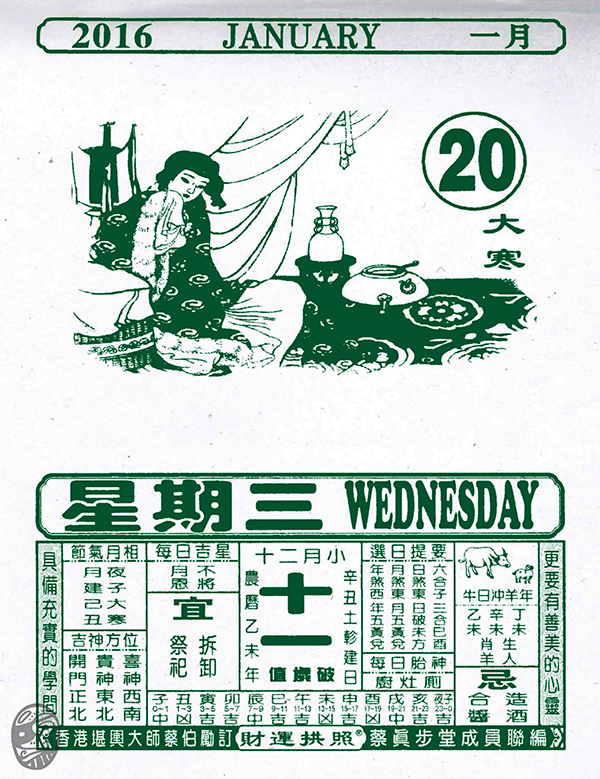
相片:在下家鄉傳統的農曆日曆 -
是日為農曆乙未年己丑(十二)月辛丑(十一)日,公曆二零一六年一月廿日,及本年最後一個節氣 - 「大寒」。
Photo: tRADITIONAL dAILY aGRICULTURAL cALENDAR (also called as lUNAR calendar) from my hOME –
tODAY is: the 11th day of the 12th month of the 32th year Yiwei (traditional Agricultural calendar), 20th of January 2016 (gREGORIAN calendar), and the lAST sOLAR tERM of the year – “sEVERE cOLD”.
***
曆|cALENDAR
有朋友問道:「為什麼《除夜》一詩中會提到春天?」
A friend asked: “Why is the ‘sPRING’ mentioned in the poem ‘Old Year’s Day‘?”
這可要從我們的曆法說起。
Then let’s begin with our calendar.
曆
Calendar
華夏文化有自己的一套曆法-傳統農曆。
The Great Chinese culture has its own set of calendar – traditional Agricultural calendar.
歷史上記載,相傳黃帝(公元前二六九八年-二五九八年)制定了曆法,是現今傳統農曆的原形。古時,人民主要以務農為生,而為求生活平安順利,人民需要一套有用的曆法。因此,傳統的華夏曆法不只是計算日子,還可以提供天文、氣象、地理及風水等重要的科學資訊。同時,在這數千年間,歷代創造了超過一百部曆法,並經過不斷的改良、修正及薪傳,傳統農曆至今仍被重視及應用於生活之中。
According to the historical records and the legend, the Yellow Emperor (2698-2598 BC) invented calendar, which is the prototype of today’s traditional Agricultural calendar. In the ancient time, people mainly lived by farming, and in order to live safely and smoothly, people need a useful calendar. Therefore, the traditional Agricultural calendar is not just counting the days, also offers astronomical, meteorological, geographical and geomantic etc. important scientific information. Moreover, the past dynasties had created more than hundred sets of calendars in the thousands of years, and by continuously improving, correcting and passing on, the traditional Agricultural calendar is still respected and applied to life.
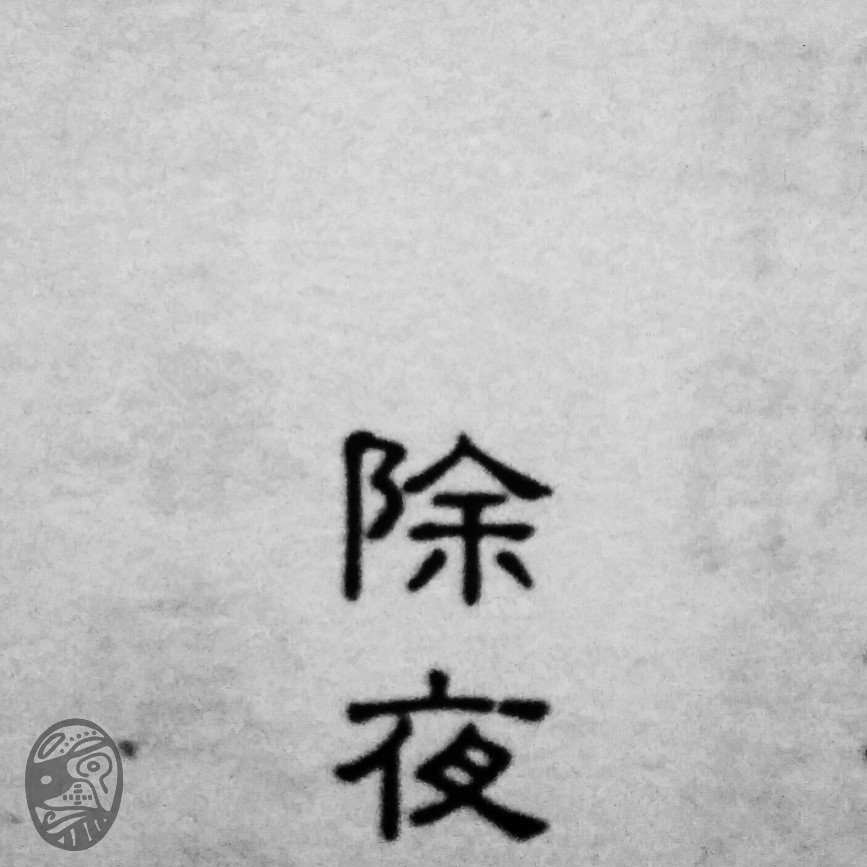
除夜|oLD yEAR dAY
一年之末,
一年之始,
一夜之思。
The end of the year,
The start of the year,
The thinking of the night.
王諲 或 史青【未能證實的詩人,唐朝開元盛世(七一二至七四二年)之初期】-《除夜》:
Wang Yin or Shi Qing [Unconfirmed poets, the early of Kaiyuan (peak) period of Tang Dynasty (712-742)] – “Old Year’s Day”:
今歲今宵盡,明年明日催。
寒隨一夜去,春逐五更來。
氣色空中改,容顏暗裏回。
風光人不覺,已著後園梅。
This year ends tONIGHT, tOMORROW urges next year to come.
wINTER ends over the night, later sPRING comes in the morning.
Climate and colours cHANGED in the air, and people are rEJUVENATED.
People are not aware of the aDVENT of Spring, in fact he has tOUCHED the plums in the backyard.
恕|cONSIDERATE
恕,如人之心,將心比己。
Feel empathy for others, tREAT others hEARTS as yOURS.
《論語》的第十五書《衛靈公》— 第二十四章:
“The Analects”*₁, Book 15 – Chapter 24 (original written in Classical Chinese):
×××
子貢問曰:「有一[言₁]而可以終身行之者乎?」
子曰:「其[恕₂]乎!己所不[欲₃],勿[施₄]於人。」
Zigong*₂ asked: “Is there a [wORD₁] that people can carry for the whole life?”
Confucius*₃ said, “That would be “[cONSIDERATE₂]”! Do nOT [dO₄] to others what you do nOT [wANT₃] others to do to you.”
×××
..,
nOTES:
*₁: “The Analects” or “Analects of Confucius” – collected sayings and thoughts of great philosopher Confucius; it is one of the important canonical Confucian literature. Traditionally people believe that “The Analects” was written by disciples or followers of Confucius during the late Warring States period (475-221 BC) and its final revision was completed during the Emperor Cheng period (33-7 BC) in late Western Han Dynasty (206 BC-9).
*₂: Zigong was one of the most important and loyal disciples of Confucius. Among Confucius’ students, he was the second best at speech, after only Zai Yu.(Wiki)
*₃: Confucius (551–479 BC) was an educator, philosopher and official of Lu State in the late Eastern Zhou Dynasty (ca. 1043-256 BC) during Spring and Autumn Period (770-476 BC), he was the founder of Confucianism and developed his Confucian theory of the five virtue elements: benevolence, righteousness, courtesy, wisdom and trust.
般若|pRAJNA, hANNYA
一個充滿怨恨的女人帶著《般若之面》- 鬼
A hATEFUL woman in a “Hannya mask” – gHOST.
「般若」,簡言之,梵語意為智慧,並可除怨恨,惟於現今日本文化多被視為「怨恨纏身」。
“Prajna”, in brief, means wisdom in Sanskrit, and can end hate, however, it (Hannya) is more considered as being “hateful (hate-ridden)” today in Japanese culture.
*Atman – (Toshio Matsumoto,1975)
Youtuber: Maelstrom Lord