
逝、陷、欺、罔|gO, tRAP, lIE, fOOL
逝、陷、欺、罔|gO, tRAP, lIE, fOOL
「君子之仁」與「婦人之仁」。
“Real benevolent” VS “Overly benevolent”.
《論語》的第六書《雍也》——第二十六章:
“The Analects”, Book 6, Chapter 26:
宰我問曰:「仁者,雖告之曰:『井有仁焉。』其從之也?」
子**曰:「何為其然也?君子可[逝₁]也,不可[陷₂]也;可[欺₃]也,不可[罔₄]也。」
Zai Wo* asked: “There is a benevolent person, if someone told him, ‘Something humane happened in the well.’ Will that benevolent person follow to go? ”
Confucius answered: “How can it be? Real man can [go to cHECK₁], but cannot [fall into the tRAP₂]; can [listen to lIES₃], but cannot [blindly be fOOLED₄].”
山、雲|cLOUDS, mOUNTAIN
山、雲|cLOUDS, mOUNTAIN

在工作過後,回家的路上,無意間看到這座雲霧金字塔就聯想到了以下這首詩:
On the way home after work, accidentally saw this cloud pyramid and thought of the following poem:
賈島 (詩人,七七九年至八四三年)之《尋隱者不遇》:
Jia Dao’s (Poet, 779–843):
「松樹下問童子,言師採藥去。只在此[山₁]中,[雲₂]深不知處。」
“Asked a boy under the pines, he told me that the teacher went to pick herbs.
Just in this [mOUNTAIN₁], but I do not know where is the teacher because of the deep [cLOUDS₂] around the mountain.”
..,
萬象|pHENOMENONS

直、德|jUSTICE, gOOD

直、德|jUSTICE, gOOD
xxx
《論語》的第十四書《憲問》——第三十六章:
“The Analects”, Book 14, Chapter 36:
或曰:「以德報怨,何如?」子曰:「何以報德?以[直₁]報怨,以[德₃]報[德₂]。」
Someone asked: “What about returning good for evil?”
*Confucius answered: “What to return for good then? We should return evil with justice and good for good.”
xxx
正體字|tRADITIONAL cHINESE
正體字|tRADITIONAL cHINESE
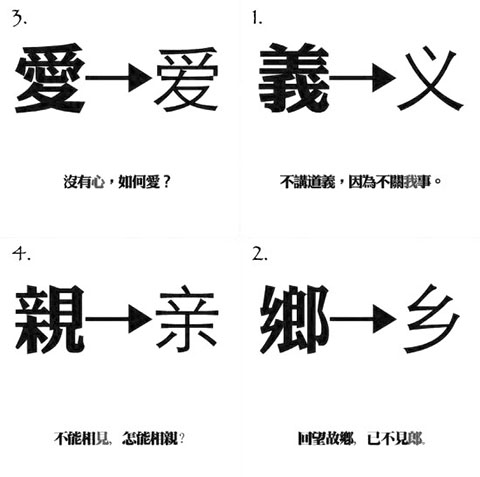
在下相信愛用正體字的人有著同樣的執著,更不想任由這些美麗的文字和華夏文化的命脈被一個錯誤如斯無情的摧毀。
If people ask me about learning Chinese. First of all, please start with Traditional Chinese.
I believe that Traditional Chinese characters lovers have the same strong will, and don’t just want to let these beautiful words and the lifeblood of Great Chinese culture be ruthlessly destroyed by a mistake.
A credited-unknown picture was spread earlier on internet, it’s telling how meaningful of Traditional Chinese characters (left) in a quite straight way:
阿豺折箭|Mùróng Āchái: bREAKING aRROWS
阿豺折箭|Mùróng Āchái: bREAKING aRROWS
上回說到⋯⋯《阿豺折箭》 。
Recap… the Story of “Mùróng Āchái: breaking arrows”.
阿豺有子二十人,緯代,長子也。阿豺又謂曰:「汝等各奉吾一支箭,折之地下。」俄而命母弟慕利延曰:「汝取一支箭折之。」慕利延折之。又曰:「汝取十九支箭折之。」延不能折。阿豺曰:「汝曹知否?單者易折,眾則難摧,戮力一心,然後社稷可固。」
阿豺就是南北朝時吐谷渾國王——「慕容阿柴」,而對於其他相關的注釋,大家可搜尋坊間各處。其道理則十分淺白,「單者易折,眾則難摧」。
The story of “Mùróng Āchái*1 and his 20 sons” version is the most recent used Chinese versions.
工具|tOOLS

漢中粵|yUE iN hAN
漢中粵|yUE iN hAN
有人問道:
「粵語是否從國語中進化出來?」
Someone asked:
“Did Cantonese evolve from Mandarin then?”
拙見:
非也。粵語遠在百越/粵部落時期,南越(公元前二零三年至公元前一一一年)立國前,已於南方發方展。由於當時秦朝(公元前二二一年至公元前二零六年)中原區戰事頻生,南方民生相對較穩定,文化受到保護,並得以繼承,歲月足有二千年之久。亦因如此,粵語保留了不少古音,尤其唐朝(六一八至九零七年)和宋朝(九六零至一二七九年)時期。故此,不少學者普遍認為以粵語誦讀/唱古詩詞歌賦是比較有韻味。
In my humble opinion:
No. Yue first developed in the South around the period of “*Hundred Yue” (means hundred of Yue Tribes) and before the Southern Yue (203 BC-111 BC) was established. Due to frequent wars around Qin’s (221 BC-206 BC)) Central Plains area, livelihood was relatively more stable in the South and their cultures were protected and inherited, it’s been more than two thousand years. Also because of that, Cantonese has preserved many ancient pronunciation, especially in the time of Tang Dynasty (618-907) and Song Dynasty (960-1279). Therefore, scholars generally agree that reciting or chanting ancient/Classical Chinese poetries in Cantonese is more charming.
一支竹仔|lITTLE bAMBOO sTICK
一支竹仔|lITTLE bAMBOO sTICK
香港人有一首歌——《一支竹仔》,是說「團結就是力量」(家和萬事興 的主題曲,1956):
Hongkongers have a song called “Little bamboo stick” (theme song of the movie “A Peaceful Family will Prosper”, 1956) which is telling about “Unity is strength”, unprofessional translated lyric as below-below:
Continue reading